


Tjörn pea
$4.00
(Pisum sativum)
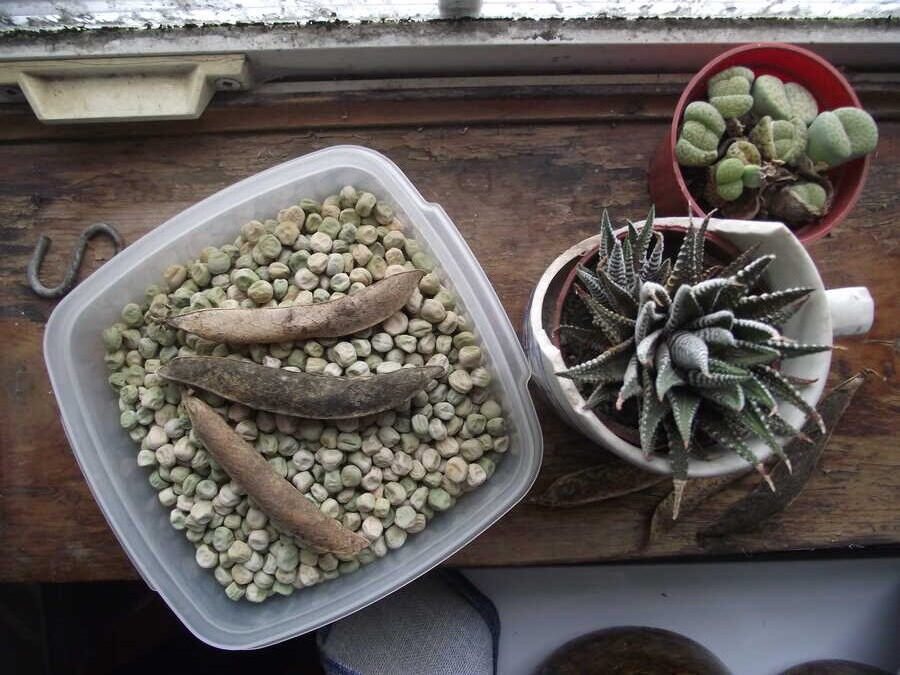
A 5’/1.6 m tall ”grey” pea. Large, olive-green wrinkled seeds with distinctive dark hila. Matures about 3 weeks later than most dry peas, and therein lies a sort of long story, so please make sure you are settled comfortably before reading on.
For my personal diet, I divide dry peas into two classes: grey (large wrinkled seeds that retain their shape when cooked and are used more like chickpeas) and white (green or yellow, round seeds which go mushy when cooked and are the classic split pea). Because they are so culinarily different, I like to have a good supply of each. A few years ago I noted that one of our white peas, ‘Golderbse’, matured substantially later than all our other varieties. I was intrigued: different maturity dates could reduce the risk of crop failure (if we have a lot of rain just when they mature), and reduce the frantic busyness of harvest time by spreading out the work. So I went looking for a grey pea which was similarly late-maturing.
I learned that in the southern provinces of Sweden such peas were once widely grown. Called raber in Bohuslan and puggor in Skåne, they are mostly similar: very large, olive-green seeds with dark hila on tall vines. I tried out a few and noted that they were quite susceptible to powdery mildew, a very common disease of peas. I knew that there is some genetic resistance to it, however. So I obtained all the puggor I could find in the Nordic Baltic Genebank and trialled them to see if there was any variation in powdery mildew resistance. Not terribly scientific, but ‘Tjörn’ was one of the top three accessions.
And a bit of history from the Donor Remarks on NordGen: “Grey peas were grown on a large scale in Skåne until 1945. In the past, it was common to sow the peas in the plough furrows. At harvest, the fields were cut with a scythe or later with a mower. Another way was to pull up the entire pea plant. The peas were then harvested and dried on hässjor. After this, the peas were threshed, the finest ones being saved for seed. After threshing, people sat at the kitchen table on autumn and winter evenings and “pelade”, sorting peas and beans according to quality – for seed, for fodder and for food. This work was something they hated as children, says Lennart Björck, who has grown this grey pea for 40 years in Skåne. Lennart got the grey pea from a friend at Tjörn 40 years ago.”
A few cultural notes of explanation for the non-Swede (like me): Tjörn is a large island just off the coast of Bohuslan on the west side of Sweden, facing Denmark. A hässja is an ingenious trick which every gardener of dry peas and beans should know about: it is a fence-like structure with upright posts about the height of a person (pictured in the gallery images). Each post has pegs spaced evenly up it about a foot apart. Long poles are then laid from post to post, and the pea vines are hung on the poles to dry after harvest. Using a hässja makes harvest much easier, since you can harvest before the plants are completely dry and brittle (and prone to shattering) and then don’t need to worry as much about rain, since the hässja lets them dry faster.
NordGen Accession # NGB 18053. 35 seeds/packet.
In stock
Plant as soon as ground can be worked. Sow 1” deep and 2” apart, in a double row 8” wide (if gardening in rows) or in rows every 8″ (if planting a field). Trellis if necessary with twine or netting. Harvest dry peas when pods and vines are turning brown and dry and seeds can no longer be dented with a fingernail.