


Auvergne Hatif turnip
Price range: $4.00 through $10.00
(Brassica rapa)
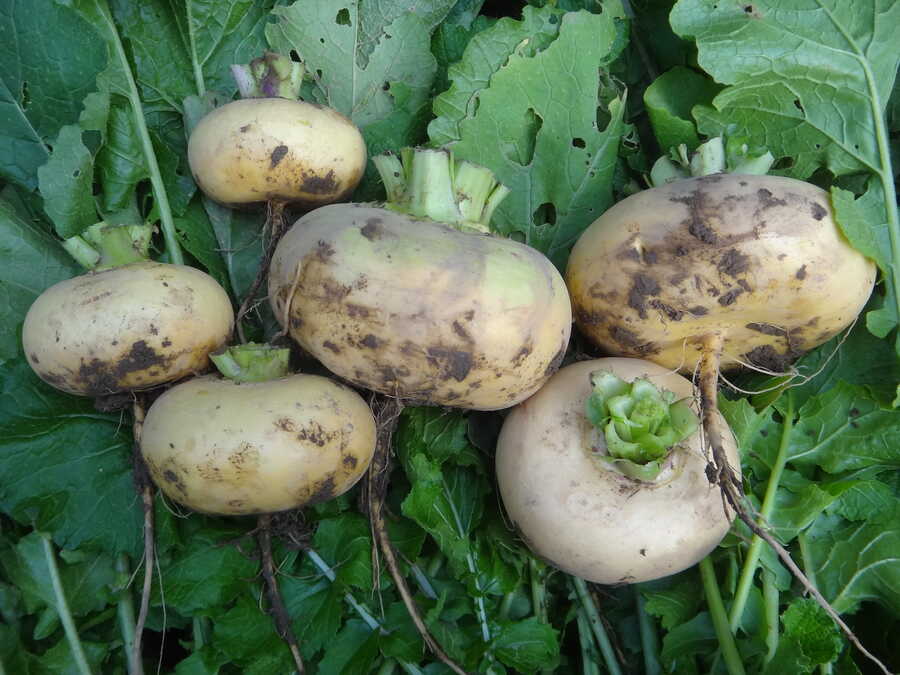
A purple-topped, white-fleshed turnip with flattened roots which is fast-growing, ideal for an autumn crop. Heirloom variety from France with a mild, sweet, nutty flavour; excellent raw, stir-fried or in soups, for all you gourmet turnip-eaters out there. I received this variety from Seed Savers Exchange’s Heritage Farm in Decorah, Iowa, where it is SSE Accession #127684.
In 1856 the legendary French seed house Vilmorin-Andrieux of Paris described the Navet Rave d’Auvergne in their Description des Plantes Potagères, noting that the turnips of Auvergne (a region in central France) were excellent, but quite late-maturing. So they had selected their strain to be earlier (hatif being French for “hasty” or “early”). They are still selling it today, now called the Rave d’Auvergne Hâtive.
By 1920, Vilmorin had divided their Auvergne turnips into two varieties. Their descriptions from that time are given below in full.
“Early Red-top Flat Auvergne Turnip. – Root very flat on the top, about 2 in. deep, and often 6 or 7 in. across ; skin very smooth, and a rather pale violet-red for the whole of the upper portion of the root ; flesh white, rather soft and watery ; leaves tall, divided, broad, and numerous. This is a very productive variety, and does best in granitic or schistose soils. It is more grown for feeding cattle than for table use.
The local strains of Auvergne turnip are very numerous and cannot well be divided into early and late sorts ; the beautiful Lezoux variety is an example of this : it is quite flat below and above, about three times as broad as it is thick, and attains the size of a Basque beret or cap, which it resembles in shape. In a sense it is early, as it bulbs rapidly, but, on the other hand, it takes a long time to develop fully.
Late Auvergne turnip. – Root two-thirds sunk in the ground, top-shaped, but tolerably flattened, 3 or 4 in. deep, and about 6 in. across ; the upper portion is of a violet-red, or rather dark bronzy colour ; leaves broad and stout, more tufty in growth and darker in colour than those of the Early variety. This variety is even more suitable for field culture than the preceding one, being seldom grown for table use outside of its native district. The central plateau of France, on account of its elevated position, possesses a climate very favourable to the cultivation of large-sized Turnips ; and there we find the two largest kinds of Turnips that are grown in France, namely, the Auvergne and the Limousin varieties.
The Ayres Turnip, which is grown in the departments of Tarn and Tarn-et-Garonne, appears to us to be identical with the Late Auvergne Turnip” (The Vegetable Garden…, Vilmorin-Andrieux, 1920, 748).
Though Vilmorin’s are experts, I wish to respectfully tender my opinion that this is one of my favourite Turnips for table use. Maybe tastes have changed, or maybe mine are simply bovine, but…
For summer harvest, plant several weeks before frost-free date. For fall harvest and winter storage, plant 45-50 days before first fall frost. Sow ¼-½” deep, 1” apart in rows 15” apart. If soil is dry, flood furrows before seeding. When plants are 4” tall, thin to 6” apart (eat thinnings). To prevent root maggot, sprinkle bed with ashes just as seedlings emerge. Harvest after a few light frosts but before a hard freeze, when roots are 3” in diameter.