
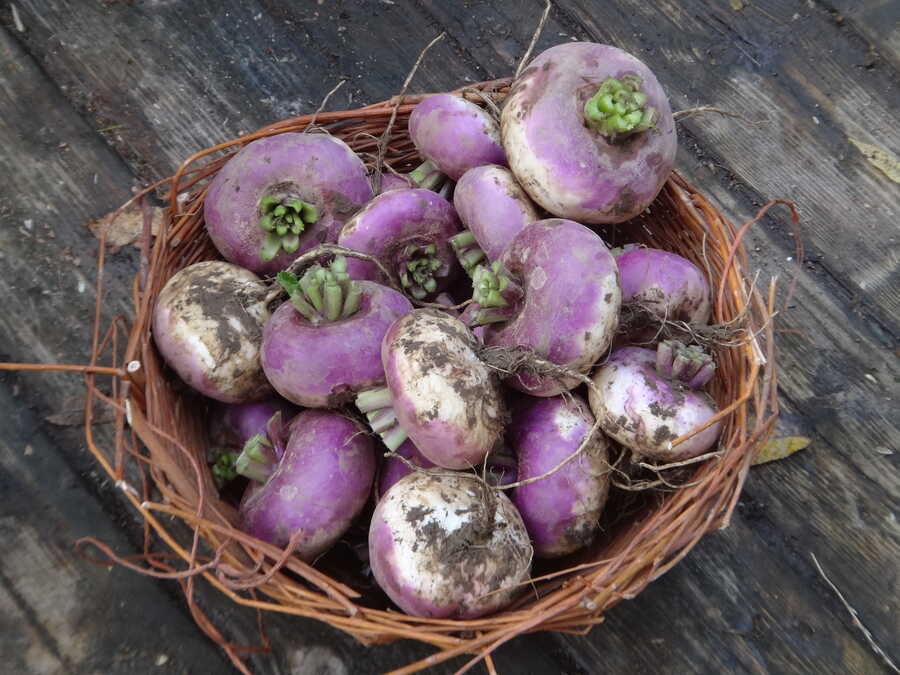


Kaski Nauris turnip
Price range: $4.00 through $10.00
(Brassica rapa)
Yellow, flattened roots. One of my personal favourite vegetables. The flavour is excellent, raw or cooked; sweet and nutty with the mildest tinge of that sulphurous burn unique to the brassicas. The flattened shape makes them easy to harvest and cut up. And they store all winter in our root cellar – impressively long for a turnip. Delightful all around.
This variety also comes with an interesting history. I acquired it from Seed Savers Exchange’s Heritage Farm in Decorah, Iowa. They received it in 1998 from Clive Blazey, one of the founders of Australia’s Diggers Club, which has led in preserving OP & heirloom seeds Down Under. Blazey had received the turnip from Mrs. Hjortman-Punbbinen, and elderly seed saver from Finland who lived in Yosemite, New South Wales, Australia.
Intrigued, I have been slowly exploring this turnip’s trail in Scandinavia. Apparently, “Kaskinauris” turnips are a type or class of landrace, not a specific variety. There are many local variations. Over the centuries, the Forest Finns lived and migrated across a wide region of what is present-day Finland and northern/central Sweden. They practised slash-and-burn agriculture, following two main patterns. Huuhta involved burning old-growth conifer forest on a long rotation, often 80 years. Kaski involved burning the young deciduous regrowth (probably mostly birch, willow and poplar) on a 15-30 year cycle. Nauris is Finnish for turnip, for the linguistically curious. They grew mostly rye and barley; then, after harvesting the grain crop, they would plant these turnips, which kept them supplied with vitamin C through their long, dark winters. Apparently the turnips grew well in the ash after the grain stubble was burned. We still sprinkle wood ash from our stove on our root brassicas to deter root maggot.
For those interested in learning more about the Forest Finns’ agricultural system, I recommend this 1930 film on Svedjebruk from Nordiska Museet in Stockholm, Sweden
SSE Accession # 127692
For summer harvest, plant several weeks before frost-free date. For fall harvest and winter storage, plant 45-50 days before first fall frost. Sow ¼-½” deep, 1” apart in rows 15” apart. If soil is dry, flood furrows before seeding. When plants are 4” tall, thin to 6” apart (eat thinnings). To prevent root maggot, sprinkle bed with ashes just as seedlings emerge. Harvest after a few light frosts but before a hard freeze, when roots are 3” in diameter.